The YCBT Services Blog

Considering a Social Anxiety Support Group? Here's What Actually Happens in the Room
If you've thought about joining a social anxiety support group, you've probably also thought about backing out. The mind gets loud fast:
- What if everyone can tell how nervous I am?
- What if I freeze and can't think of anything to say?
- What if I'm the only one who feels this out of place?
- What if it's worse than doing this alone?
Here's the paradox nobody mentions: the exact discomfort that's talking you out of the group is the same discomfort the group is built to treat. That's not a coincidence, and it's not a sign you're not ready. It's social anxiety doing exactly what social anxiety disorder does — making the room feel more dangerous than it actually is, and making avoidance feel like relief instead of what it actually is: the thing keeping the fear alive.
In individual therapy, you can talk about the fear of being judged. In a group, you get to test it — in a room built for exactly that, alongside people working through the same fear, not watching you fail at it. That's why structured group work is often where the real, lasting change happens for social anxiety: not despite the social component, but because of it.

Insomnia and Shy Bladder Syndrome: When "Sleep Effort" Meets "Pee Effort"
You're lying in bed, doing the math on how many hours of sleep you'll get if you fall asleep right now. You squeeze your eyes shut a little tighter. You tell yourself, sternly, to relax. And somehow that makes it worse.
Or maybe it's a different kind of pressure. You're standing at a urinal, or waiting outside a single-stall bathroom, acutely aware that someone could walk in any second. You will your body to just go. Nothing happens. The longer you stand there, the more locked up you feel.
These two moments have almost nothing in common on the surface — one happens in bed at 2am, the other in a public restroom. But they run on the exact same broken logic: the harder you try, the less your body cooperates.

When "Having It Together" Is Actually Social Anxiety: A Look at Perfectionism in Irvine's High-Achievers
"What if they realize I don't actually know what I'm doing?"
"I can't ask that question in the meeting — everyone else clearly already gets it."
"I need to seem like I have this handled, even if I'm drowning."
If any of these thoughts feel uncomfortably familiar, you're not alone — and you may be dealing with something more specific than everyday work stress. In a city like Irvine, home to a dense concentration of tech companies, biotech firms, and one of the most competitive university environments in the country at UC Irvine, this pattern shows up constantly in my office. What looks like ambition or high standards on the outside is often, underneath, social anxiety wearing a very convincing disguise.
Beyond Blue Light: Why Your Phone Keeps You Awake (From a CBT for Insomnia Specialist)
We’ve all heard the advice a thousand times: Turn off your screens before bed because blue light disrupts your melatonin. So, what do many of us do? We buy blue-light blocking glasses, switch our phones to "Night Shift" mode, and keep right on scrolling.
But if you’ve tried these hacks and still find yourself tossing and turning, staring at the ceiling while your mind races, you aren't alone.
As a psychologist specializing in Cognitive Behavioral Therapy for Insomnia (CBT-I), I talk to clients every week at our Orange County, CA private practice who are incredibly frustrated that their "sleep hygiene" fixes aren't working. The truth is, while light spectrums do matter for our circadian rhythms, we’re missing the bigger culprit. The primary reason screens wreck our sleep isn't optical—it's emotional and cognitive.
It’s not the light keeping you awake; it’s the content.
WHY YOU ARE ACTUALLY SUPPOSED TO GET OUT OF BED WHEN YOU CAN’T SLEEP
We’ve all been there: staring at the ceiling, watching the minutes tick by, and feeling the growing pressure to fall asleep. Your brain starts calculating how many hours of rest you’ll get if you fall asleep right now. In the world of Cognitive-Behavioral Therapy for Insomnia (CBTi), this is the moment when it is likely recommended for you to get out of the bed. But why? Many people are under the impression that getting out of bed is supposed to be a trick to help you fall asleep faster on one given night…not necessarily so! Read on to learn the real reason why and when getting out of the bed can be so important for long-term sleep quality.
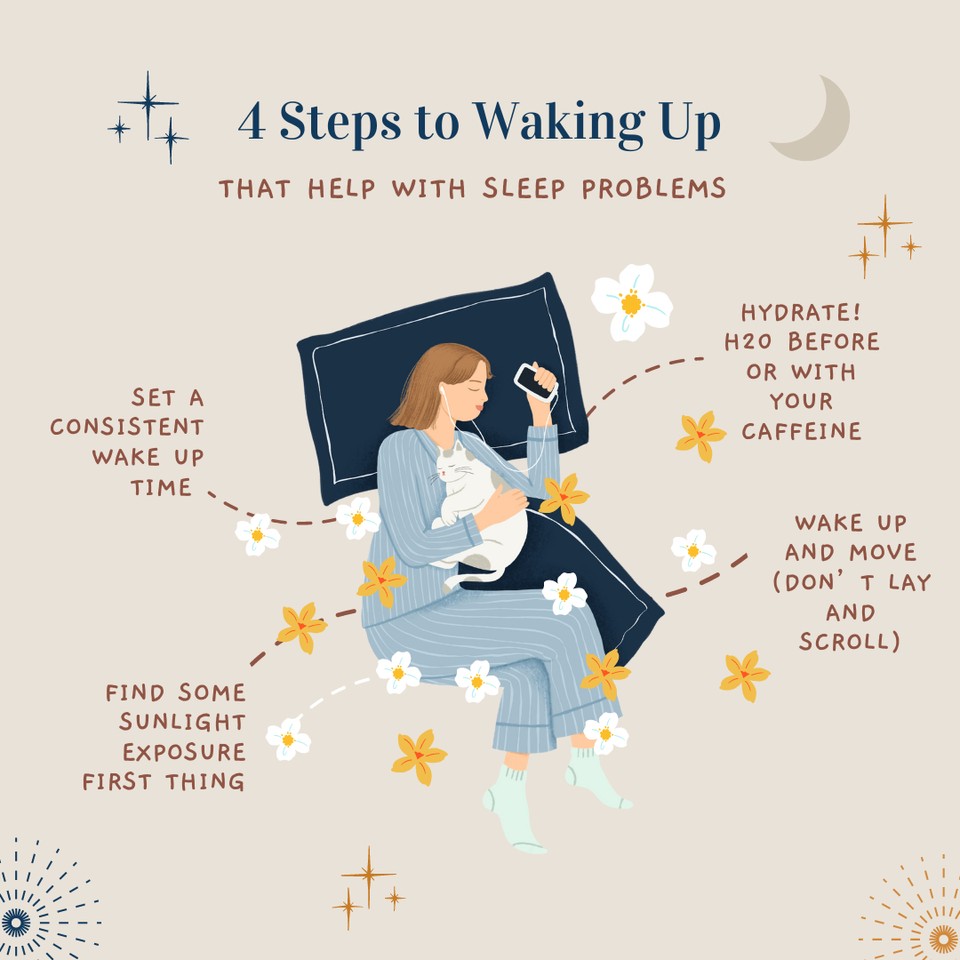
4 Essential Morning Steps to Help With Sleep Problems
How does a morning routine impact your ability to sleep at night?
A consistent morning routine serves as a vital anchor for your circadian rhythm—the internal biological clock that dictates your sleep-wake cycle. When we struggle with sleep, we often focus solely on the "bedtime" side of the equation. However, by intentionally engaging in specific "wake signals" like sunlight and movement, we can effectively regulate the physiological triggers that allow us to feel tired when the lights go out.
WHY DO WORRY THOUGHTS GET IN THE WAY OF SLEEP? AND WHAT TO DO ABOUT IT!
Worry thoughts trigger the body’s sympathetic nervous system, creating cortisol-driven hyperarousal that prevents the brain from transitioning into the sleep state. When the brain perceives a threat or a challenge—even a mental one like financial stress or "sleep performance anxiety"—it remains in a state of high vigilance, which is a primary driver of chronic insomnia.

FOUR KEY STEPS IN OVERCOMING SHY BLADDER SYNDROME
Paruresis, also known as shy bladder syndrome, describes a form of social anxiety in which a person experiences distress and/or difficulty urinating in the presence of others. Specifically, a worry regarding being judged by others or “exposed” as having difficulty or not being able to pee “normally” is often at the core of great apprehension and avoidance of trying to urinate in public.
Behavioral Experiments for Social Anxiety Disorder
Watch the VideoMarijuana and CBD: Benefit or Harm for Anxiety?
Watch the Video
YCBT Services is proud to be the San Clemente regional clinic for the National Social Anxiety Center, which was established to make quality psychotherapy services available to those in need.
Through research, collaboration and educating clinicians and the public, NSAC is committed to improving services and care for people seeking help for social anxiety. Visit NSAC here for more information about Social Anxiety.